 Mobile
Public transport with a mobility scooter — Vienna & Salzburg
Both Vienna and Salzburg have invested significantly in barrier-free public transport. Many U-Bahn stations, trams, buses, O-Buses, S-Bahn trains and the Salzburger Lokalbahn are equipped for wheelchair and mobility-scooter users — often with low-floor vehicles, ramps and lifts. The picture is not 100 % uniform, though: some older vehicles, individual stops and special situations may still need a moment of planning. This guide collects the practical points scooter visitors most often ask us about. Please always confirm current details on the official operator pages linked at the bottom before your trip.
Accessible public transport — maps & routes
Plan step-free journeys with elevators and low-floor vehicles:
Wiener Linien — Accessibility →Vienna City Map →Salzburg Verkehr →

In this guide
1. Why public transport matters for scooter visitors
A mobility scooter gives you independence on foot routes — sightseeing, parks, pedestrian zones — and it folds (or partly disassembles) for transport. Public transport extends that radius enormously. In Vienna, the U-Bahn moves you across the city in minutes; in Salzburg, the O-Bus reaches almost everywhere inside the city and the Lokalbahn opens up the surrounding region. Combining a scooter with public transport often means less walking, less waiting, and more of your day spent at the actual sights.
2. Vienna — U-Bahn, tram (Bim) and bus

U-Bahn (metro)
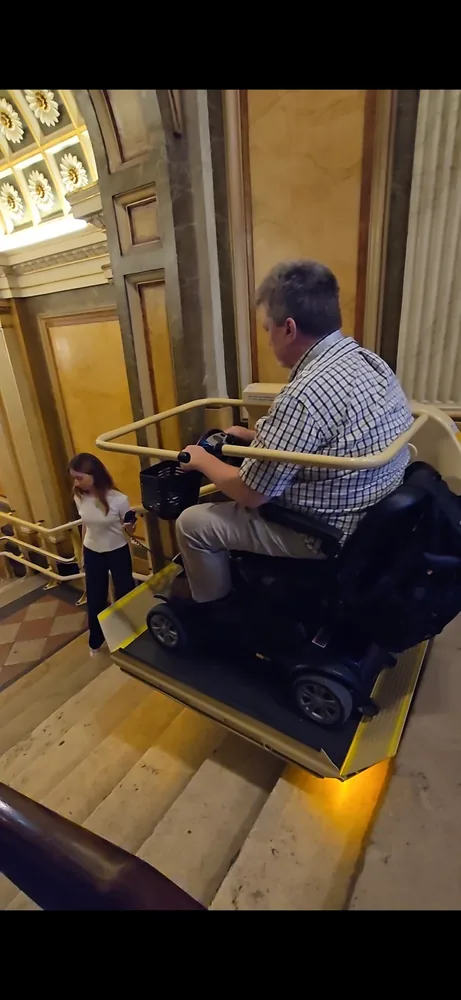
According to Wiener Linien, all U-Bahn stations are described as barrier-free accessible, equipped with elevators and tactile guidance systems along platform edges. The newer V-Wagen and X-Wagen trains additionally feature automatic folding ramps that deploy at the door when you board — V-trains at the first and last doors, X-trains at all doors. The five U-Bahn lines (U1, U2, U3, U4, U6) cover most central Vienna destinations.
If a lift is temporarily out of service, the current lift status is published on the Wiener Linien website and app. We recommend a quick check before you leave the hotel.
Tram (Straßenbahn / "Bim")

Wiener Linien states that roughly two-thirds of Vienna's tram fleet are low-floor vehicles (ULF and Flexity), with one of the lowest boarding heights of any tram network in the world. Newer Flexity models include dedicated wheelchair spaces. Drivers can deploy a ramp at the designated door on request — give a hand signal as the tram approaches the stop so the driver sees you.
Useful tram lines for scooter visitors:
- Tram 1, 2, D, 71 — the Ring tram circuit around the historic 1st district, perfect for a sightseeing loop.
- Tram D — directly to Schloss Belvedere ("Schloss Belvedere" stop).
- Tram 60 — heads towards Schönbrunn / Hietzing.
City bus
Wiener Linien states that Vienna operates exclusively low-floor city buses, which can be further lowered via the "kneeling" air-suspension function when needed. Buses are typically equipped with a folding ramp at the second door, operated by the driver. The bus network is especially useful in areas not directly served by U-Bahn or tram.
3. Salzburg — O-Bus, S-Bahn and Lokalbahn

O-Bus (trolleybus)
Salzburg's iconic O-Bus is the spine of the city's public transport. According to Salzburg AG, the fleet consists of barrier-free low-floor articulated trolleybuses with a kneeling function and fold-out ramps at the second door, operated by the driver. All O-Buses provide at least one wheelchair space; the newer HESS vehicles offer two wheelchair spaces opposite the second door, plus improved tactile stop-request buttons and contrast markings on grab bars and edges.
Standard boarding procedure: signal the driver as the bus arrives, the driver lowers the bus and deploys the ramp, you board (typically backwards into the wheelchair space), and press the request button in good time before your stop.
Salzburger Lokalbahn (regional railway, "SLB")
The Lokalbahn connects the city of Salzburg with the Flachgau region to the north. According to Salzburg AG, every train has at least one barrier-free entrance and is equipped with a mobile fold-out ramp. On-board staff can assist with boarding and alighting. Almost all stations in the Lokalbahn network are barrier-free at platform level; the operator has announced that all platforms in the network will be barrier-free by autumn 2026.
S-Bahn (regional commuter rail, ÖBB)
The Salzburg S-Bahn lines are operated by ÖBB and connect the city with Hallein, Golling, Werfen and other surrounding towns. Modern ÖBB regional trains (Cityjet / Talent) are typically equipped with low-floor entry sections and ramps; barrier-free boarding sometimes requires advance notification via the ÖBB barrier-free hotline. Please check the current ÖBB accessibility information for your specific route.
4. Tickets and validity
For up-to-date ticket prices, please check the official operator pages directly — fares change periodically and we do not want to publish outdated numbers here. The typical ticket types available are:
- Vienna (Wiener Linien / VOR): single tickets, 24-hour, 48-hour, 72-hour, weekly and monthly tickets. The 24 / 48 / 72-hour tickets are usually the best value for short stays. Buy via the WienMobil app or at any U-Bahn ticket machine.
- Salzburg (Salzburger Verkehrsverbund): single tickets, 24-hour day tickets, and weekly tickets. The 24-hour ticket usually covers the city O-Bus network. For longer regional travel (Lokalbahn, S-Bahn), zone tickets apply.
- Salzburg Card (tourist card): often includes public transport within the city plus free or reduced entry to most museums — useful if you plan several paid attractions in one or two days.
People with a recognised disability ID may be entitled to reduced fares — always carry the document and ask at the ticket office.
5. Practical tips for scooter users
- Signal early. Drivers cannot always see you between waiting passengers — a clear hand signal as the vehicle approaches helps.
- Use designated doors. Wheelchair / scooter access is normally at the second door of trams, O-Buses and city buses (the door closest to the wheelchair space).
- Avoid peak hours when possible. Roughly 07:00–09:00 and 16:00–18:00 are busiest. Mid-morning and early afternoon are calmer and easier for boarding.
- Reverse-in. In wheelchair spaces, you usually park backwards against the wall, brake on, motor off — this is the safest position for sudden stops.
- Charge fully overnight. A fully charged Classic+ (~20 km range) easily covers a day of sightseeing with public-transport hops in between.
- Cobblestones. Both Vienna's and Salzburg's old towns include cobblestone sections. Drive slowly; both Classic and Classic+ handle them, just with a bit of vibration.
6. Apps: WienMobil and Salzburg Verkehr
Both regions offer free official apps that combine route planning, live departures, ticket purchase and accessibility info:
- WienMobil (Wiener Linien) — route planning, real-time departures, lift status of U-Bahn stations, ticket purchase. Available for iOS and Android.
- Salzburg Verkehr — official app of the Salzburger Verkehrsverbund. Route planning across O-Bus, Lokalbahn and S-Bahn. Tickets included.
- ÖBB — for nationwide trains (e.g. Vienna ↔ Salzburg by Railjet). Booking and reservations possible.
7. Combine public transport with a Mobile4Ever scooter
Our typical guests use the scooter mainly for foot routes — between hotel, restaurants, and sightseeing — and add public transport for longer distances within the city or to outlying districts. Two simple combinations work very well:
- Vienna: hotel → U-Bahn (or tram) → Schönbrunn, Belvedere, Prater. Scoot the grounds, return by U-Bahn / tram.
- Salzburg: hotel → short scoot to the nearest O-Bus stop → Altstadt → scoot the historic centre, lunch break, return by O-Bus.
We deliver the scooter directly to your hotel by 10:30 AM, pick it up on your departure day, and give you a short walk-through on operation and charging in English or German.
Request a quote WhatsApp